15 Years
Teacher Innovator(s): Sabzagul Khuromonova
Learning Area
Biology | Collaboration | Creativity | Critical Thinking | Literacy | Technology
How might we make students excited about biology lessons?
THE CONTEXT
Secondary Public School #12
The village of Tusyon is located in the Roshtqala district of the Gorno-Badakhshan Autonomous Oblast in Tajikistan.
Like many other villages in the district, Tusyon provides equal access to secondary education for both boys and girls at Secondary Public School #12, which was built 50 years ago during the Soviet era. The school currently has an enrolment of 331 students and employs a teaching staff of 36.
THE CHALLENGE
How might we make students excited about biology lessons?
Sabzagul Khuromonova, a biology teacher at the school, is deeply committed to her students’ success and strives to make her lessons engaging. During the ‘Explore’ stage of the Human-Centred Design (HCD) process, she interviewed students as well as observation and discovered a lack of motivation and engagement in Biology class, creating major barriers to improving student outcomes.
A lack of resources also contributed to their disinterest, as did a lack of professional development training on modern methodologies, which has impacted the teacher’s ability to be creative in planning and implementing lessons. As a result, few students had shown interest in biology classes.
The HCD approach has helped me generate effective teaching and learning ideas and apply them in practice. I now confidently use this approach in other classes, as it consistently leads to positive learning outcomes.
Sabzagul Khuromonova, Biology teacher
THE INNOVATION
Project-Based Biology
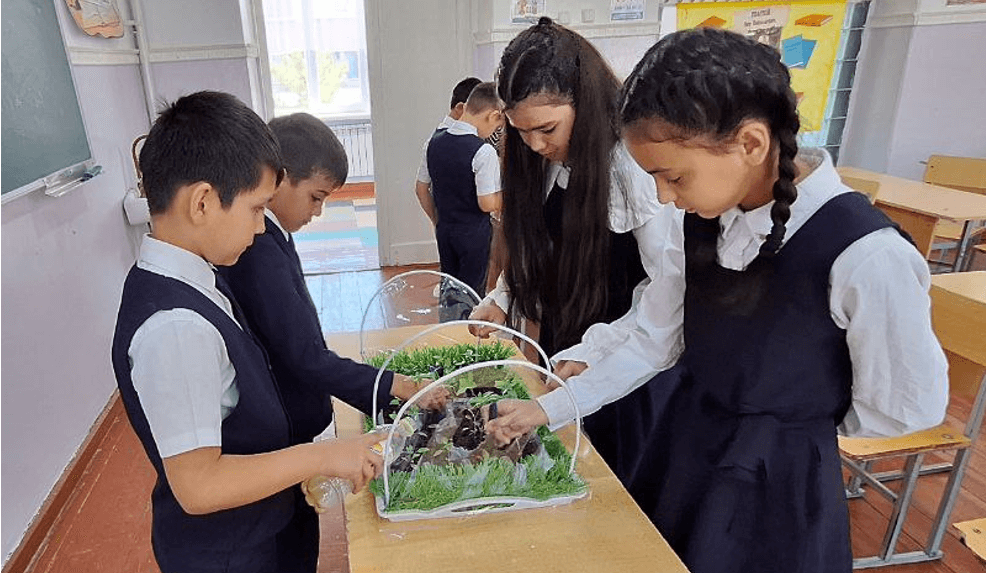
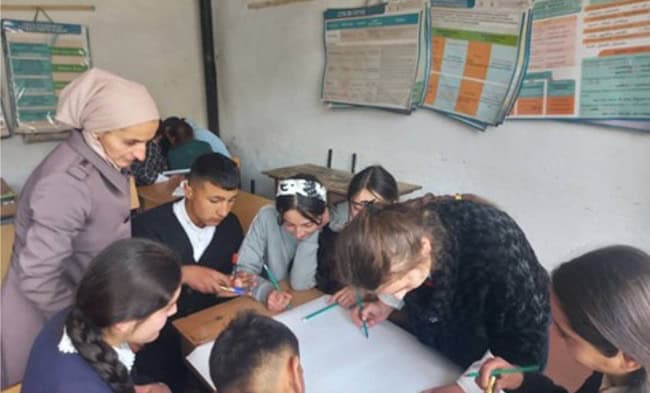
Through HCD, Sabzagul developed an approach that involved assigning students topics and projects to work on together, encouraging active participation and collaboration. Students have to research their topic and present their findings through various formats, by creating presentations, posters, or interactive models.
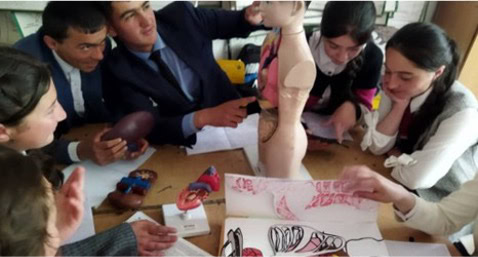
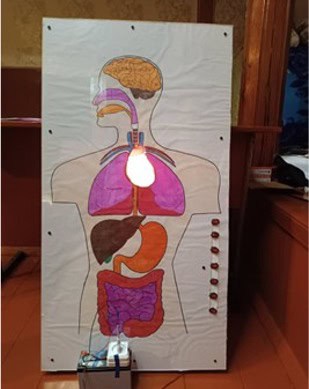
One notable example involved students creating a model illustrating human body parts. To demonstrate how these body parts function, students incorporated wires and batteries into their model. This innovative approach improved students’ understanding of the subject matter while highlighting their creativity through the construction of models to explain biological processes, such as the functioning of organs.
THE IMPACT
More confident, curious students skilled in presenting and debating
Sabzagul reports that her lessons have become easier and more enjoyable, with students actively assisting and engaging throughout the process. Individual and group research tasks have motivated students to explore topics deeply, while resources provided by AKF have significantly enriched the classroom environment.
Students are now more confident, curious, and skilled in presenting, debating, and discussing topics. Their improved engagement has led to participation in district, regional, and national competitions, with one student achieving national recognition in Biology at the “Science is the Source of Wisdom” competition.
The receipt of the National Award in the “Science is the Source of Wisdom” competition has also served as a powerful stimulus for other students to further develop their knowledge and skills and take part in various competitions.
Encouraged by these outcomes, Sabzagul has expanded the approach to other grades, building a culture of innovation and active learning across the school. The success has also inspired colleagues, showing how the wider adoption of HCD can positively impact teachers and students alike.
RESOURCES
Download the story of this innovation in PDF form below.
Our school and I are very proud of the National Award, and I strongly believe it is the result of the HCD approach. It has helped me generate effective teaching and learning ideas and apply them in practice. I now confidently use this approach in other classes, as it consistently leads to positive learning outcomes.
Sabzagul Khuromonova
Explore more innovations from Tajikistan