Artificial Intelligence (AI) is rapidly reshaping how the world works, learns, and connects. In education, its influence is growing fast — from how knowledge is accessed, to how learning is designed and shared. But as AI becomes more powerful, a critical question remains: who gets to shape how it is used in classrooms?
We believe the answer must be teachers.
In Lindi, Tanzania, the Schools2030 team, in with partners at EdTech Hub, are now working to do just that – to pilot new ways that teachers can shape the use of AI as classroom or teaching aids, hoping to inform the wider sector with the insights and the tools they discover through this five-month partnership.
The partnership recently brought teachers together for a three-day workshop at Aga Khan University (AKU) to explore how AI can strengthen school-based Continuous Professional Development (CPD), locally known as MEWAKA. Rather than positioning AI as something done to teachers, the workshop focused on how educators can stay in control — using AI intentionally, ethically, and practically to support peer learning and professional growth.
This work responds to a familiar challenge: while teachers deeply value learning from one another, heavy workloads, staff shortages, and large class sizes often make regular collaboration difficult. The question the workshop set out to explore was not whether AI should be used, but how it can be optimised — by teachers themselves — to make professional learning more accessible, flexible, and relevant.


Why AI in Schools2030?
Schools2030 is built on the belief that teachers are best placed to identify classroom challenges and design solutions that work in their own contexts. The Teachers in the Lead AI Sandbox, developed by EdTech Hub, aligns closely with this approach, positioning AI not as a replacement for professional judgement, but as a practical tool that supports it.
Teachers from Lindi were selected based on their prior engagement in teacher continuous professional development initiatives, their experience with Human-Centred Design (HCD) through Schools2030, and their involvement in the AKF’s Foundations for Learning (F4L) project. Together, these experiences provided a strong foundation for experimentation, reflection, and innovation.
During the workshop, AI was introduced as a “technical assistant”—helping teachers prepare Communities of Learning sessions (Jumuiya za Kujifunza), access reliable learning resources, share knowledge more easily, and strengthen informal learning networks using tools many were already familiar with.
Learning by Doing: An HCD Approach
The workshop followed an HCD process throughout. Teachers worked collaboratively to identify real challenges in their daily practice, unpack the root causes behind them, and design simple, realistic solutions they could test in their own schools.
Participants came from a range of subject areas—including mathematics, languages, science, and social studies—and all were regular users of smartphones, tablets, or laptops. Their enthusiasm and readiness to engage with ICT and AI was clear, as was their commitment to using technology to strengthen collaboration and professional growth.
Rather than focusing on theory, the sessions prioritised hands-on learning. Teachers worked directly with AI tools such as ChatGPT, Lovable, and Suno, with brief exposure to NotebookLM and Gamma. This practical engagement helped demystify AI and build confidence through real use.
AI can help speed up teaching, learning, and the ways we deal with challenges in the classroom. I expect to be a good ambassador to my fellow teachers, especially in using AI.
Madam Hadija Singilimo, Rahaleo Primary School
From Ideas to Action: Teacher-Designed Prototypes
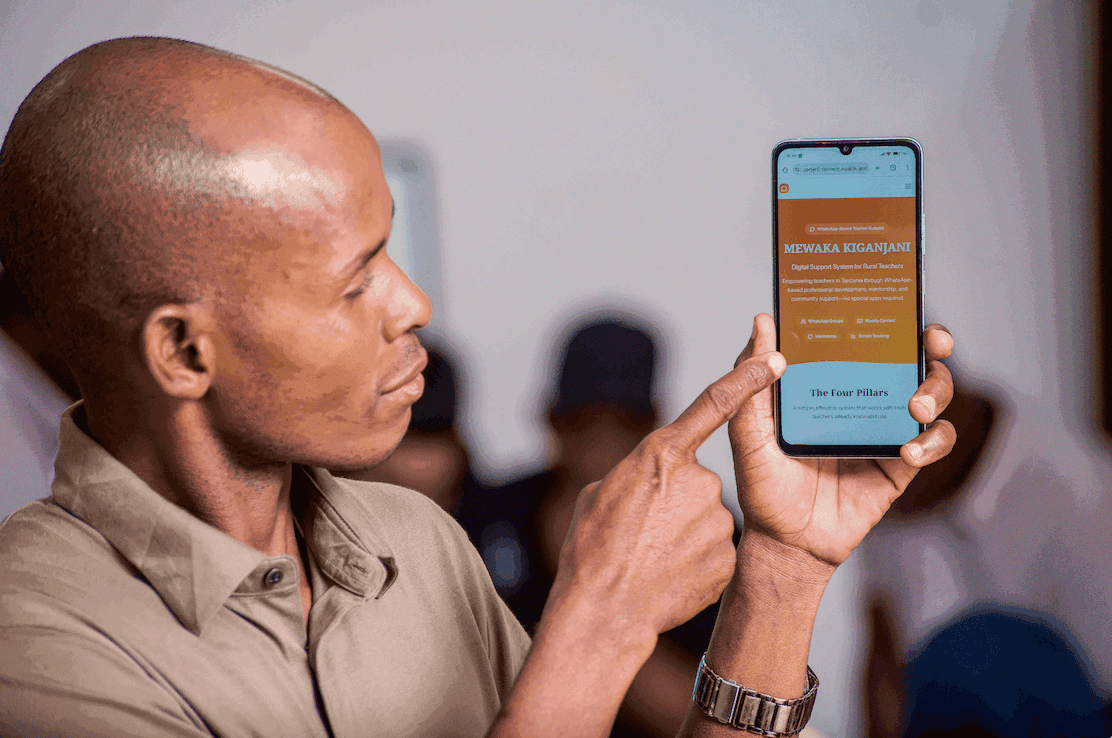
By the end of the three days, teachers had designed four digital prototypes aimed at making professional learning more accessible, flexible, and teacher-friendly:
- MEWAKA Kiganjani
Enables teachers to participate in CPD anytime, anywhere using Zoom, WhatsApp, and voice notes—without disrupting school schedules. - Mwalimu Link
A shared digital repository (LMS/Google Drive) for storing and accessing CPD materials, teaching methods, and resources for teachers with limited time for in-person sessions. - Digital JzK
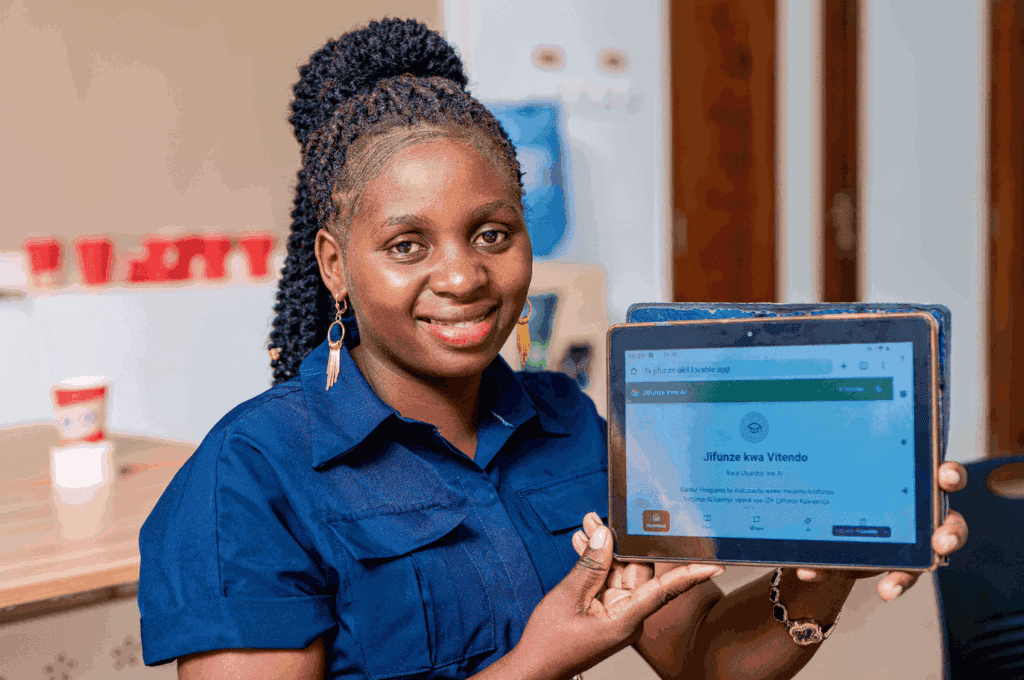
A collaborative peer-learning model using WhatsApp and Zoom to boost motivation, strengthen relationships, and enable faster access to information. - Jifunze kwa Vitendo (AI Support)
Focuses on using AI to design engaging learning sessions and build practical ICT skills, increasing teacher confidence and participation.


Together, these prototypes signal a shift away from CPD that relies solely on face-to-face sessions, towards more flexible, digitally enabled approaches shaped by teachers themselves.
Over the next four to five weeks, the prototypes will be tested in real school and peer-learning settings. Teachers will explore what works in practice – who participates, how often knowledge is shared, and whether these approaches genuinely help teachers feel more supported in their day-to-day work.
Following the pilot phase, participants will reconvene to reflect on lessons learned and explore which ideas have the potential to grow and scale across Schools2030 countries and beyond.

Staying at the Centre of the New Norm
Early reflections suggest that teachers see AI as a supportive tool—one that helps them respond more quickly to classroom challenges, access pedagogical knowledge, and strengthen professional judgement rather than replace it.
Collaboration across schools has also emerged as a key benefit, with teachers valuing the opportunity to learn collectively and build stronger professional relationships.
As AI continues to shape the future of education, this work is about ensuring teachers remain at the centre — not just adapting to change, but actively shaping how technology strengthens professional learning, collaboration, and classroom practice.