10 Years
Teacher Innovator(s): Mamta Kumari
Learning Area
Collaboration | Communication | Literacy | Numeracy | Parental Involvement
How might we strengthen foundational learning and engagement through interactive, activity-based approaches that connect lessons to real life?

THE CONTEXT
Madhya Vidyalay Nargada School, Patna
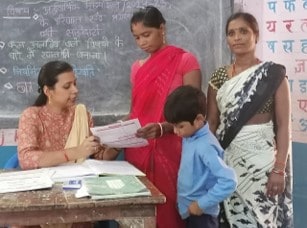
Madhya Vidyalay Nargada, located in Jamsot Panchayat, Danapur, Patna, serves 452 students, including 53 in Grade 5, and caters to a community largely made up of low to middle-income families engaged in small businesses and agriculture. The school faces significant educational challenges such as irregular attendance, low outcomes, minimal assessments, and poor student engagement. While there is an intent to involve the community in the educational process, parental participation remains low, with many showing indifference to their children’s schooling.
THE CHALLENGE
How might we strengthen foundational learning and engagement through interactive, activity-based approaches that connect lessons to real life?
One of the key challenges faced by Madhya Vidyalay Nargada was the lack of grade-level proficiency among students, particularly in subjects like Hindi, Mathematics, English, and Environmental Studies. Despite structured mid-term evaluations showing average performance, foundational learning gaps remained significant; students could often recite definitions—such as that of an “angle”—without truly understanding the concept or its real-life relevance. This gap in conceptual clarity highlighted the need for a shift in teaching methods, prompting the school to adopt more activity-based approaches. Assessment data and feedback from both students and parents revealed widespread dissatisfaction, with learning outcomes consistently falling short across both academic and co-curricular areas.
THE INNOVATION
Activity-Based Learning
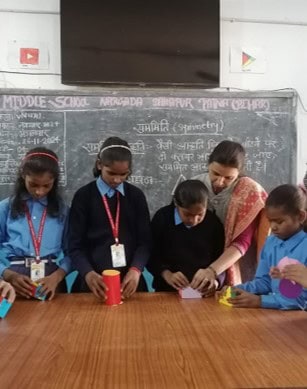
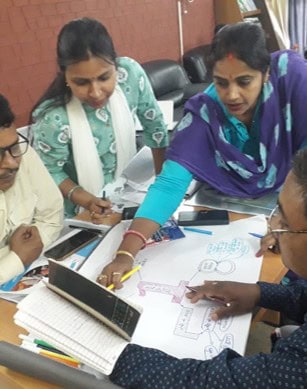
Teachers initiated conversations with parents and students to better understand their educational environment, asking questions like, “Do you talk to your child daily about their schooling or help them with reading and writing?” These interactions led to the introduction of interest-based, lesson-aligned activities – such as maths games, picture reading, and group tasks – which significantly improved engagement and participation. Activities include ‘Mama Ji Ne Laddoo Baatein’ – an interactive game built around rhyming songs, designed to teach children concepts such as group formation, number sense, place value and counting – and ‘Kitab Jhappatta’ – a group activity for parents and their children using storybooks to identify colours, animal names as well as for storytelling and promoting a love of reading.
THE IMPACT
Student learning through play and participation
The impact of this new approach has been seen across several key areas. Students are demonstrating a deeper understanding of subjects by moving beyond memorising definitions to applying concepts in real-life contexts, including identifying angles in their surroundings. Parent engagement also improved significantly, with participation in Parent-Teacher Meetings tripling after awareness sessions were conducted. Foundational learning has strengthened as more than 60% of students met or exceeded minimum learning benchmarks, reflecting clear academic progress. Student attendance increased by 35% and classrooms have become dynamic spaces, with learning transformed through the use of games, group activities, and interactive methods.
RESOURCES
Download the story of this innovation in PDF form below.
Explore more innovations from India