10-15 Years
Teacher Innovator(s): James Kazungu, Ann Njeri, Harison Chiriba Chando, Zephaniah Mwadime
Learning Area
Building Confidence | Collaboration | Numeracy | Problem-Solving | Taking Responsibility
How might we improve students’ performance in numeracy using low-cost, available learning materials?
THE CONTEXT

Bodhei Junction, Umoji, Vipingoni, and Mini Valley Primary Schools
The innovation was developed by a team of five teachers working across four primary schools in Lamu West Sub-County, serving communities in Hindi, Witu, Hongwe, and Bomani zones. Together, the schools serve 1,088 learners, including 101 Grade 3 students directly involved in the pilot. The learner population comes largely from rural farming and fishing communities, including the Boni–Awere community, where poverty, low adult literacy, poor health outcomes, and limited resources contribute to low parental engagement, irregular attendance, and truancy.
Across the schools, teachers identified shared priorities: improving learner motivation, strengthening parental involvement, reducing absenteeism, and addressing persistent gaps in foundational numeracy. Limited access to teaching and learning materials further constrained teachers’ ability to support struggling learners, particularly in early mathematics.
THE CHALLENGE
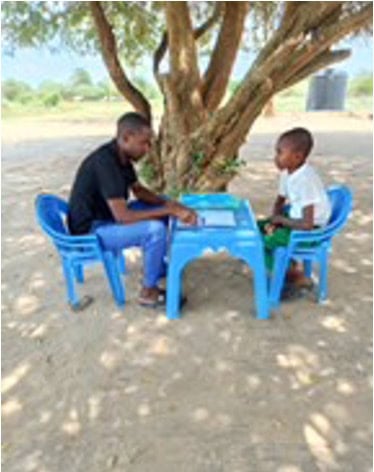
How might we improve students’ performance in numeracy using low-cost, available learning materials?
Assessments, classwork, and quizzes consistently showed that learners struggled with basic numeracy skills, especially solving word problems and division. Teachers reported that many learners found it difficult to interpret mathematical questions because of weak reading comprehension, making it hard to identify key information and select appropriate operations. These challenges were observed across multiple grades, indicating a systemic issue rather than an isolated classroom problem. As one Grade 4 mathematics teacher explained, learners found word problems difficult because they required both reading and understanding, skills many had not yet mastered. Without targeted intervention, these gaps continued to undermine confidence, participation, and overall academic performance in mathematics.
THE INNOVATION
The Smart-Split Board
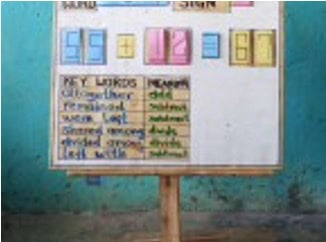
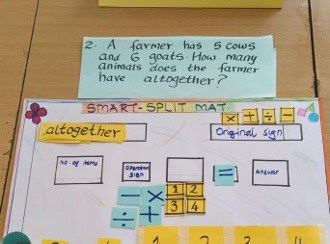
To respond to this challenge, the team developed the Smart-Split Board, a low-cost, hands-on numeracy tool designed to make abstract mathematical concepts visible and interactive. The board is constructed using locally available materials such as wooden display boards, bottle tops, sticks, carton tins, number strips, and operation signs.
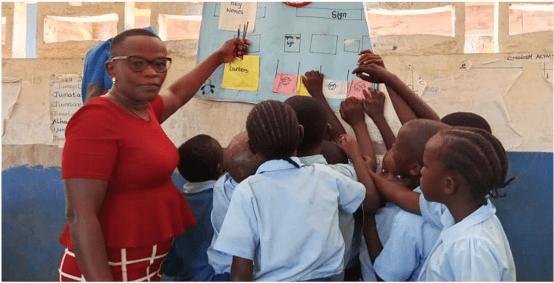
In practice, teachers display a word problem and guide learners to identify key words using a “keyword flip” approach. Together, the class reconstructs the problem on the Smart Split Board, breaking it down step by step using counters and visual representations. Through repeated testing and iteration, the tool was refined to improve durability, efficiency, and learner engagement. The approach encourages learners to work collaboratively, discuss their reasoning, and take responsibility for problem-solving, transforming numeracy lessons into participatory learning experiences.
THE IMPACT
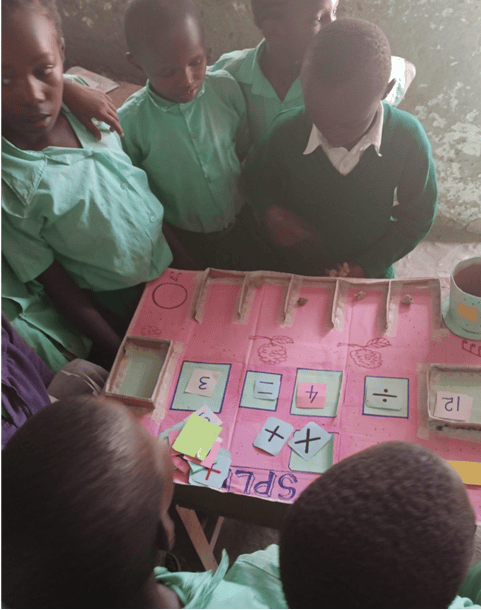
Improved numeracy through hands-on, visual problem-solving
Over a five-month pilot period, the Smart Split Board led to measurable improvements in learners’ numeracy skills. Teachers observed clearer gains in learners’ ability to solve word problems and perform division, alongside faster recall of basic facts and greater accuracy in calculations. Learners became more confident and willing to attempt problems, contributing to richer classroom discussions and higher participation. The hands-on approach helped students understand concepts more deeply by engaging multiple senses—listening, seeing, and doing—making learning easier to grasp and remember. Increased enjoyment of mathematics also made school more attractive to learners, contributing to improved attendance and reduced truancy across participating schools.
RESOURCES
Download the story of this innovation in PDF form below.
Explore more innovations from Kenya