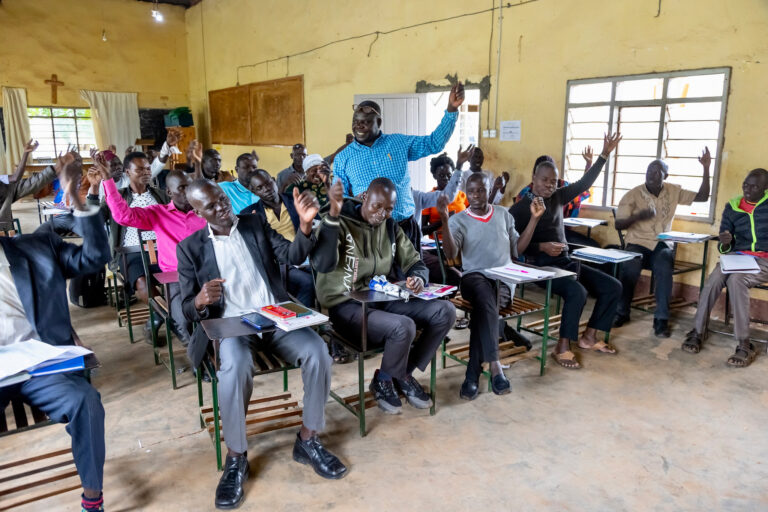
Teachers, teacher educators, researchers and policymakers from across the Schools2030 network came together for the fourth session of this year’s Virtual Forum series, this time turning to a theme that sits at the heart of everything the programme does: teacher agency and leadership.
Opening the session, Dr Bronwen Magrath, Schools2030 Global Programme Manager, set out why this matters. “When teachers are trusted and supported as leaders of learning, classrooms become more adaptive, more inclusive, and more responsive, and the quality of teaching and learning improves,” she said. “By investing in professional development that prioritizes teacher agency and innovation, education systems can transform not just individual classrooms but entire schools, building resilient, effective learning environments.”
As education systems shift from knowledge-based to competency-based curricula, teacher professional development has too often stayed rooted in older models: training focused on delivery and compliance rather than on responding to what’s actually happening in the classroom. Schools2030’s Human-Centred Design (HCD) model, co-developed with teachers across ten countries and now engaging nearly 25,000 teachers and school leaders, is one answer to that gap. Three educators from across the programme took centre stage to explain how HCD has enhanced their professional practice and sense of agency.
From Portugal: When innovation doesn’t need permission
Antonio Luciano Moraes, a history teacher in Castelo Branco, came to teaching later in his career after 18 years designing museum and cultural education programmes. HCD, he said, gave him something he’d been missing: a method for solving problems in his own classroom, rather than working alone and reacting to symptoms.
As part of an HCD course offered by the Schools2030 programme in Portugal, he used a tool called the “problem tree” – mapping consequences, a central problem, and root causes – and realised his real issue wasn’t that students disliked history, but that questioning a source wasn’t a habit in his classroom. His resulting innovation was a podcast made by his students, pairing historical sources with contemporary news items for analysis. “In the podcast, the student speaks and I’m not in the recording,” he said. “That’s something uncomfortable for a teacher, and that is exactly the point.”
The deeper shift was about authority and permission. “I used to think innovation needed permission – a green light, a budget, a formal project,” he reflected. “What the school showed me is that the space I actually control, my own classroom, my own planning, is already enough to start. The permission I was waiting for was mostly my own permission.”
From Tajikistan: Starting with people, not solutions
Dr Mohira Davlatnazarova, a teacher educator and vice rector at Khorog State University, is collaborating with the Aga Khan Foundation in Tajikistan on an initiative bringing HCD into STEM teacher training. She described a familiar tension: teachers receive good training, but the realities they return to in their classrooms are often quite different.
HCD, she explained, doesn’t replace traditional professional development – it complements it. “Traditional training can provide knowledge and pedagogical tools, while HCD can help teachers apply those tools to real problems in their own classroom.” The harder shift is one of mindset: moving teachers from being recipients of expert answers to becoming comfortable with questions, experimentation, and even failure.
Her closing reflection was simple. “One of the most important things I have learned through this process is that educational change does not always begin with a big problem or a complicated solution. It sometimes begins with a simple question: what’s the real problem? Have we taken the time to listen to the people experiencing it?”
From Pakistan: Listening as an act of empathy
Ulya Youssef, a recent graduate of Aga Khan University’s Institute for Education Development in Karachi, brought the perspective of a teacher applying HCD for the first time, as part of a GPE-KIX funded project testing the model within initial teacher education.
Working with her creative writing students, Ulya interviewed learners and colleagues directly rather than assuming she already knew the problem and discovered that vague feedback and a lack of individualised guidance, not lack of effort, was holding students back. Her response, developed with her students, was a “highlight and comment” strategy for feedback that students could actually act on.
What stayed with her most was a shift in her own role. “Now whenever there is an issue in my class, I do not take it as – being a teacher, I have to give the solution to my students,” she said. “Instead, I investigate, I probe my learners… Give them the chance to prove themselves. Empower them, and you will see the world around us bloom.”
From Kenya: Turning policy into practice
Anne Gachoya, Director of Basic Education at Kenya’s Ministry of Education, brought a system-level view, describing how Kenya’s shift to competency-based education is repositioning teachers from curriculum implementers to facilitators, innovators, and leaders of learning. “Teacher leadership turns reform from policy document into everyday practice,” she said. Policy sets the vision and the standards, she explained, but it is teacher leadership and professional development that translates that vision into classroom reality and Kenya is now investing directly in protecting space for teachers to test, reflect, and share what works.
Her closing message was a challenge to the room: “Kenya now makes an invitation to all of us that we all move from training teachers for reform, to enabling the teachers to lead the reform. To lead from the front. Learning to lead, leading to learn, transforming education together.”
Closing reflections: building the conditions for agency
Synthesising the discussion, Dr Jwalin Patel of the TIDE Foundation, one of Schools2030’s global research partners studying teacher agency in Bihar, India, offered three reflections. First, that HCD’s inquiry-based approach genuinely inverts the traditional model – teachers start from their own context rather than from theory handed down by experts. Second, a caution: individual teacher agency, however powerful, can be systemically limited by curricula, assessment systems and accountability structures far beyond any one classroom. “The question,” he said, “is how do we design environments in which teacher agency is not just possible, but is fostered and nurtured, both within the classroom and also beyond it.” And third, that this work cannot be treated as a one-off course: it has to become a culture of professional learning.
He closed with the question that had shaped his own research career: “How do we bring about transformative and holistic education for all? It is perhaps through activating teacher agency – but also through creating conditions, environments, systems, and most importantly, relations in which teacher agency can flourish.”
Closing the session, Dr Magrath pointed to why this conversation reaches beyond any one classroom or country. UNESCO’s Teacher Task Force estimates the world needs 44 million new teachers by 2030. But as she put it, “this is not just about numbers.” What’s needed, she argued, is a shift in how the whole sector thinks about the profession: a post-SDG global education consensus that puts teachers at the centre, recasts teaching as a collaborative and transformational profession, and treats teacher professional development as a lifelong endeavour rather than a series of one-off trainings.