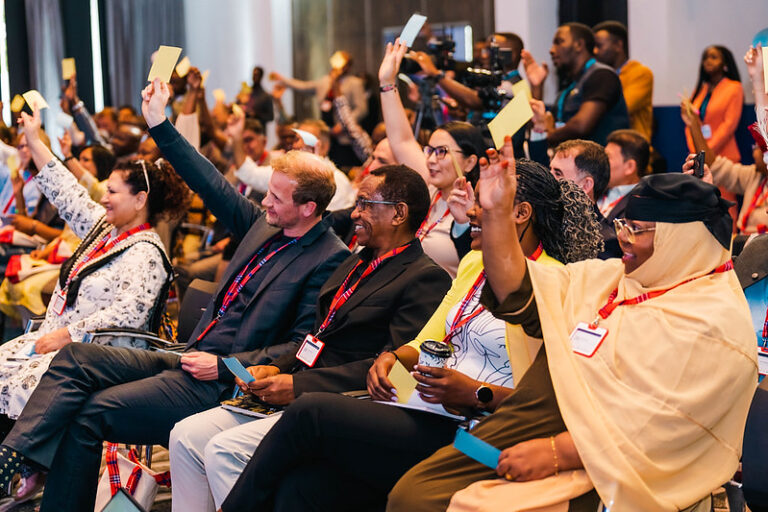
On 7 May 2026, teachers, school leaders and educators from across the Schools2030 network came together for the second session of our 2026 Virtual Forum series: Accelerating Results — Leveraging Evidence in and for Classrooms.
Three frontline speakers took centre stage to share what changes when teachers lead assessment — not as an administrative exercise, but as a genuine tool for understanding their students and improving their practice. They were joined by two of the sector’s most respected voices, who reflected on what those classroom stories mean for the wider education system.
Andrew Cunningham, Global Lead for Education at the Aga Khan Foundation, chaired the session with characteristic warmth and precision — drawing threads between speakers, opening space for honest reflection, and ensuring that the weight of each contribution landed before moving on.
From Uganda and East Africa: Assessment that belongs to teachers
Emily Tusiime, Regional Assessment Coordinator for Aga Khan Foundation East Africa, opened by describing what assessment looked like before Schools2030: paper-based, top-down, driven by administrative need rather than classroom insight. Teachers assessed because they were told to, not because they expected anything useful to come from it.
What changed was ownership. Teachers across Uganda, Kenya and Tanzania were involved from the very beginning — defining the domains they wanted to measure, co-creating the tools, piloting them with their own students. For many, it was the first time they had sat one-on-one with a learner and really looked at what they understood.
One story captures what that can unlock. A teacher at Kiswa Primary School in Uganda, piloting an assessment for empathy, was shocked by what the results revealed. She could barely believe the data — so she designed her own additional assessment to check it. When the results were confirmed, she went directly to her head teacher. A school-wide intervention followed. Funding came. Something changed.
“Teacher-led assessments,” Emily reflected, “is something that had been undervalued in the past. But teachers are at the centre of improving learning outcomes. If we want to make change, wherever it happens has to be in the classrooms.”
From Kyrgyzstan: A guide for good teaching
Gulzat Musabekova, a primary school teacher at Chkalov General Secondary School in Naryn City, described what assessment looked like before Schools2030 in simple terms: it checked what students knew. Nothing more.
What the programme introduced was something different — tools that looked at the whole child, and tools that turned the lens on teachers themselves. For Gulzat, the VITAL classroom environment observation tool became what she called “a guide for good teaching.” Its dimensions — emotional climate, critical thinking, facilitation of learning, relationships — gave her a framework for asking questions she hadn’t previously thought to ask. Are children safe enough to try? Are my questions open-ended enough to invite real thinking? Am I treating each child according to their own level, their own home environment, their own wellbeing?
“We are able to ground our work in real data rather than assumptions,” she said. “We used evidence to find the core problems in our teaching practices and then came up with ideas to solve them. As a result, we’ve looked at our professional experience in a completely new way.”
From Pakistan: From alarming to actionable
Nabila Atta is headteacher of Government Girls’ Higher Secondary School in Garam Chishma, Chitral — a school where success had long been measured in exam results and percentages. That, she said, is now changing.
What struck her most when her school first engaged with Schools2030 assessment tools was the reaction of officials. The results were, in her word, “alarming” — not just for teachers, but for the inspectors and policymakers who saw them. Rather than being buried, those results prompted closer observation of classroom practices and, eventually, something more significant: a shift from annual to semester-based assessment across the system, allowing for more continuous feedback and earlier intervention.
“It’s essential to establish direct interaction and platforms across all levels of the education hierarchy,” Nabila said, “so that challenges can be communicated and addressed in a timely manner.”
Her account is a reminder that evidence generated in classrooms doesn’t have to stay there. When teachers have tools they trust, and data that reflects reality, it can travel — upwards into policy, outwards into systems.
The wider conversation: evidence, agency and investment
The teacher presentations were followed by responses from two of the session’s most senior voices — and between them, they reframed what the classroom stories meant for the global education agenda.
Jo Bourne, Chief Technical Officer at the Global Partnership for Education, responded to each speaker with the recognition of someone who has seen these dynamics play out across many systems. GPE works through partnership — with governments, with grant agents, with implementing organisations — to unlock the funding and technical support that makes change possible at scale. But that partnership, she was clear, depends on results. In a tough global funding landscape, where education competes for resources against other urgent priorities, it is not enough for everyone to agree that education matters. Evidence of what works, generated reliably and used purposefully, is what makes the case for continued investment. Without it, even the most compelling moral argument struggles to convert into funding.
Professor Yusuf Sayed of the University of Cambridge drew out a thread that ran through all three speakers without any of them naming it directly: teacher agency. Each of them, in their own way, had described what happens when teachers are not passive recipients of assessment data but active agents in generating and interpreting it. That, he suggested, is not incidental to the approach — it is the approach.
He also offered a way of thinking about evidence that reframes what assessment is really for. Evidence, he argued, is both relational and purposeful. It is a social tool — built in dialogue, between teachers and students, between teachers and mentors, between schools and systems — and it is always asking a question: why is this working? Why are we doing what we are doing? Assessment at its best is not measurement for its own sake. It is practice with purpose.
What the conversation affirmed
Together, these five voices made a case that Schools2030 has been building across five years and ten countries: that assessment is most powerful when teachers are its authors, not its subjects. When data is generated with teachers rather than extracted from them, it becomes something they can act on — in the moment, for the child in front of them, and over time for the whole school and the systems beyond it.
The first step is always the hardest. As Emily put it: “When you’re measuring something that has not happened before, the first thing that happens is the panic. But the moment we gave teachers samples of the assessments, it became very, very easy. And even some teachers went ahead and designed their own.”
Watch the full session recording above — and join us for Part Three on 25 June 2026.