10-15 Years
Teacher Innovator(s): Dariyakan Sarybaeva, Gulnaz Maturaim Kyzy, Peri Bakal Kyzy, Janargul Abdramanova, Aksana Islamova, Kunduz Ybyshova, Abdraeva Bermet, Elnura Keneshova, Bubatma Karakojonova
Learning Area
Critical Thinking | Entrepreneurship | Numeracy | Respect for the Environment | Science | Taking Responsibility
How might we develop student's skills in using theoretical knowledge of mathematics in real life?


THE CONTEXT
Toktogul Secondary School, Osh
Sopu Korgon village located in the Alay district at an altitude of 3000 meters above sea level, with a fairly harsh climate, with cold winters and cool summers. The village has a population of over 3,200 residents and the main sources of income for the local population are cattle breeding and crop production, with a focus on rapidly growing crop varieties.
More than 500 students attend Toktogul School, but they face a common challenge: excessive use of gadgets, which often leads to a lack of focus in class. As a result, students struggle to pay attention and absorb the material being taught.
The primary challenge faced by the students of Toktogul School was their difficulty in translating theoretical mathematical knowledge into practical applications. While they were able to understand mathematical concepts in the classroom, they struggled to use these concepts effectively in real-life situations. This gap in their skills meant that the students lacked the ability to perform basic calculations and solve problems outside of the academic environment, such as in everyday tasks and daily life scenarios. The ability to apply knowledge in practice is crucial and represents an essential skill that students must develop.
THE CHALLENGE
How might we develop student's skills in using theoretical knowledge of mathematics in real life?
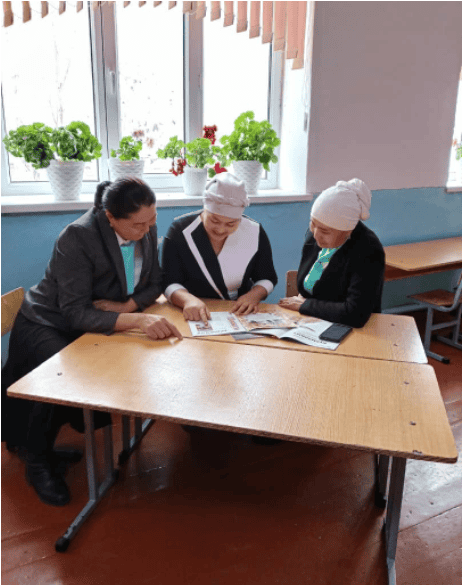
The design team chose to focus on the significant challenges students face in learning mathematics. This decision was based on assessment data, classroom observations, and conversations with students, teachers, and parents. Results showed that students’ math achievement averaged just 38%, with over 80% reporting difficulties in the subject. Some ninth-grade students even struggled with basic calculations—one student, Mirbekov Dauren from Grade 9B, admitted, “Of course, I am very ashamed to admit it, but I have a hard time even with simple calculations when I need to multiply and divide. Every math lesson is stressful for me.”
Interviews also revealed a striking contrast: many students aspired to start their own businesses and understood that math was vital to achieving those goals. This combination of low performance and high motivation inspired the team to design solutions that would strengthen students’ mathematical understanding and confidence while connecting these skills to their future ambitions.
THE INNOVATION
Greenhouse Math: Applying math to real life
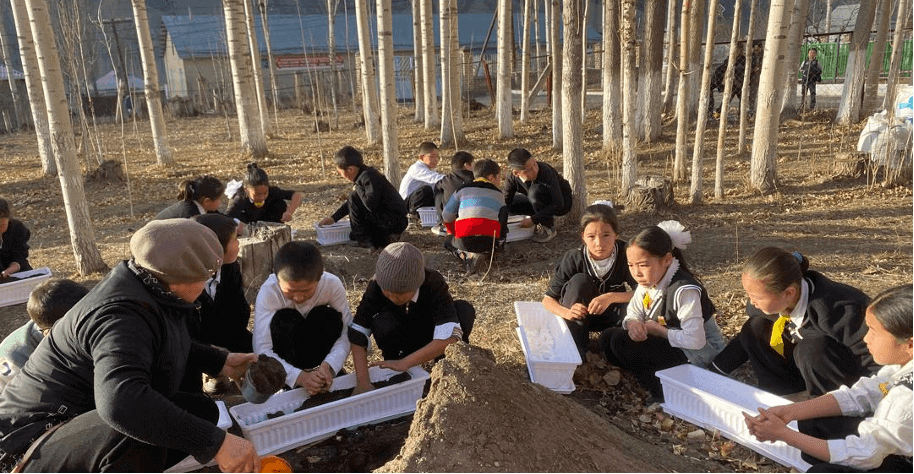
Through this initiative students apply their mathematical knowledge in a real-world setting by running small businesses inside a renovated school greenhouse. These include planting and selling houseplants, producing bio-humus, and cultivating greens such as dill and green onions, transforming theoretical learning into practical skills.
Planting and Selling Houseplants
In this business, students grow and sell houseplants like cyclamen and violets. They calculate production costs for seeds, pots, soil, and labour, set selling prices, and analyse profit margins. By examining how scaling production affects costs and profits, students gain a practical understanding of pricing, cost efficiency, and financial planning.
Vermicompost Production
Students producing bio-humus learn to estimate raw material needs, calculate both fixed and variable costs, and develop pricing strategies to maximise profitability. They explore how production volume influences costs and revenue, strengthening their ability to make data-driven decisions about scaling and pricing.
Cultivating Greens
By cultivating dill and green onions, students forecast crop yields, analyse market demand, and project revenues based on expected output and pricing. This activity emphasises the importance of market research and statistical analysis, helping students balance supply, demand, and profitability while optimising production.
Across all ventures, students apply fundamental mathematical formulas to manage budgets, control inventory, and analyse performance. This hands-on experience helps them see mathematics as a vital tool for decision-making, building entrepreneurial confidence, problem-solving ability, and a deeper understanding of business strategy.
THE IMPACT
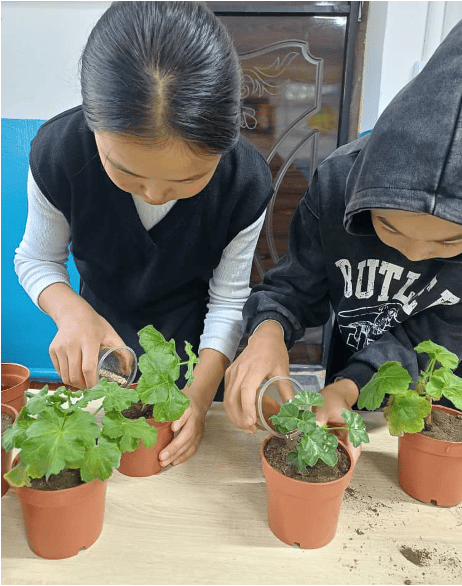
Students are now directly applying their theoretical math knowledge to real-world business scenarios, bridging the gap between abstract concepts and practical entrepreneurship. They use key mathematical principles—algebra, calculus, and statistics—to analyse financial data, forecast trends, and develop pricing strategies. As one student shared, “We organised a successful fair where we sold flowers and dill. Before the event, we carefully calculated our expenses to set the right prices, which taught us the importance of budgeting and making data-driven decisions.”
The endline assessment showed remarkable progress among Grade 9 students. Math performance increased by 28%, with average scores rising from 38% to 66%. Literacy scores improved from 32% to 70%, while critical thinking rose from 48% to 79%, responsibility from 51% to 83%, and leadership from 44% to 79%. These results demonstrate not only stronger academic achievement but also significant growth in students’ confidence, problem-solving, and leadership.
Greenhouse Math also has shifted how students perceive learning itself, transforming mathematics from a challenging subject into a practical and empowering tool for success. By linking education to real-life outcomes, the project cultivates both entrepreneurial mindsets and essential life skills, inspiring students to see themselves as capable innovators.


RESOURCES
Download the story of this innovation in PDF form below.
We organised a successful fair where we sold flowers and dill, and it was an incredibly valuable experience. Before the event, we carefully calculated our expenses to set the right price for our products. This process taught us the importance of budgeting and how to make data-driven decisions.
Student, Toktogul Secondary School
Explore more innovations from Kyrgyzstan