Every year, the Comparative and International Education Society (CIES) conference brings together researchers, practitioners, and policymakers grappling with the same set of hard questions: whose learning are we counting, who gets to decide what counts, and how do we make sure the answers actually serve children and the communities around them? This year, those questions felt sharper than ever — and what struck me most was that Schools2030 wasn’t just in the room for them. We were woven through the program in ways that reflected how far this work has come: across our own panels, through our research partnerships, and in sessions that touched on our shared questions even when they weren’t explicitly about us.
Three threads kept surfacing across those conversations.
We measure what matters — but for whom?
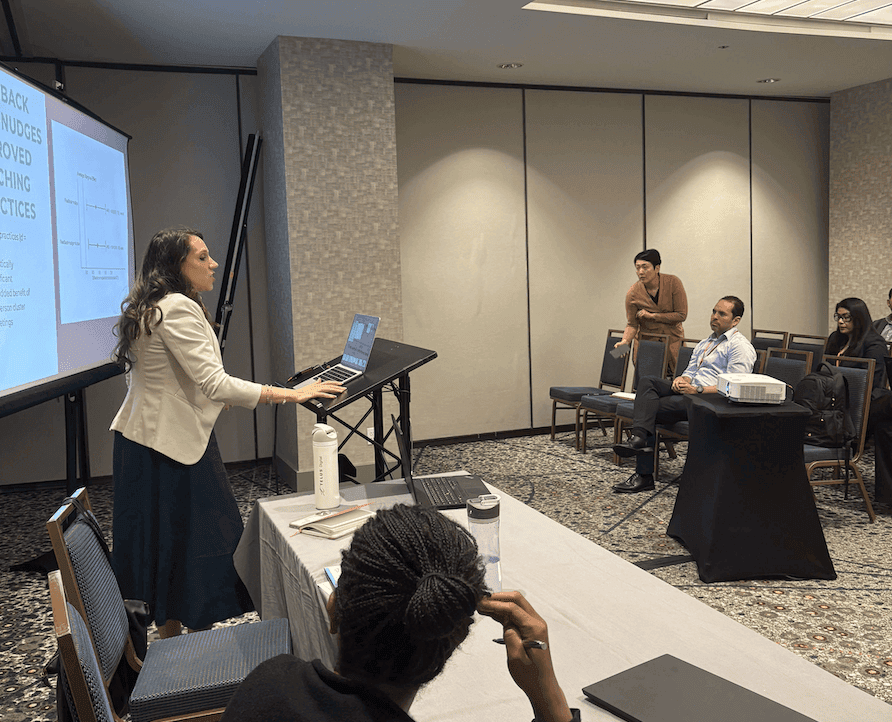
Our research partners at ECD Measure and Sightsavers co-convened a joint panel anchored around the Brief Early Childhood Quality Inventory (BEQI) — a 90-minute observational tool they’ve developed and refined across more than 20 countries. The panel brought together four BEQI studies in a single conversation, and between them they wrestled honestly with one of the oldest tensions in our field: how to build a measure of early learning quality that is meaningful in a village in one country, a refugee camp in another, and a ministry dashboard in a third — all at once. What made the panel unusual was that it didn’t treat measurement, system-level scaling, teacher practice change, and disability inclusion as separate conversations. It showed how a well-designed tool can hold all four together.
The foundation paper drew on 565 classroom observations across Ethiopia, Guinea-Bissau, Kenya, Liberia, and Tanzania, and reported an 86% average alignment between BEQI core items and national early childhood standards — with consistent strengths in teacher-child relationships and urgent gaps in play-based learning and language-rich conversations. The Tanzania paper then showed what this looks like when the work moves from validation to system-level implementation: the Watoto Wetu Tunu Yetu programme scaled a hub-and-spoke model across eight councils in Dodoma, using BEQI alongside teacher Knowledge, Attitude and Practice surveys and the International Development and Early Learning Assessment (IDELA) to manage variability and sustain quality gains across diverse schools. The Mombasa study went a layer deeper, showing that measurement can be the lever for teacher practice change, not just the mirror of it: a four-month randomised control trial (RCT) with 129 preschool teachers found that BEQI-based feedback, paired with low-cost WhatsApp nudges and cluster meetings, shifted pedagogical practices by meaningful margins (effect sizes of 0.6 to 0.9) across all teacher profiles, without reliance on intensive in-person coaching.
What the panel made visible was the iteration and messiness behind this work — that building assessment systems alongside teachers and communities is slow, relational, and often humbling, and that this is a feature, not a bug
The fourth paper took the same toolkit into disability inclusion — participatory action research in Homa Bay and Mombasa counties in Kenya, piloting BEQI additions that include enumerator disability-awareness training, a teacher information sheet with inclusion-focused self-reflection questions, disability data collection during classroom observation, and disability-focused feedback for teachers. With recent data suggesting that 10–20% of children in mainstream government early years classrooms have functional difficulties, the additions were welcomed by teachers and enumerators alike — though they flagged persistent constraints around stigma, identification, teacher capacity, and accessible infrastructure. This is work closely connected to our own BEQI and VITAL tool development at Schools2030, and it tees up the second thread directly.
What the panel made visible across all four papers was the iteration and messiness behind this work — that building assessment systems alongside teachers and communities is slow, relational, and often humbling, and that this is a feature, not a bug. This is a design challenge we know well at Schools2030, where our Assess step has always tried to hold this tension rather than resolve it prematurely.
Inclusion changes the picture
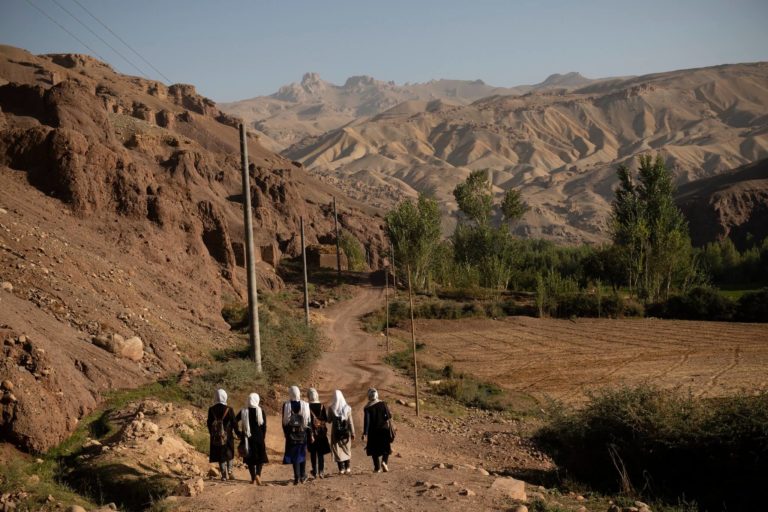
If the BEQI disability-inclusion paper showed what inclusion looks like when it’s designed into measurement from the ground up, Rayana Abuzaid and Najibullah’s joint paper on AKF’s Multi-Year Resilience Program (MYRP) in Afghanistan — delivered in partnership with Education Cannot Wait, CARE International, and eight local NGOs — extended that question into the starkest possible context. In a country where an estimated 1.4 million girls have been denied secondary education for four consecutive years and boys’ enrolment is also falling, MYRP has brought grade 1–6 community-based education and Accelerated Learning Programmes to within three to five kilometres of children’s homes, reaching nearly 37,000 students (two-thirds of them girls) in its first year. What struck me most was the way the design treats inclusion as the theory of change, not a target: gender-responsive pedagogy, social-emotional learning and mental-health support embedded in teacher training, flexible response funds for assistive devices and medical referrals, and school-management shuras that root safeguarding and peace-promoting norms in trusted local bodies. The baseline evidence — girls outperforming boys in literacy, near-zero absenteeism, early shifts in household attitudes toward girls’ education — is striking in its own right, but the deeper argument was that these outcomes emerge when classrooms are treated as microcosms of peaceful society and families are engaged as the ultimate ripple layer.
Taken with the BEQI disability-inclusion work, the message of this thread was consistent: inclusion is strongest when it’s the thing producing the outcomes, not a box to be ticked alongside them.
Teacher agency — and the system conditions that enable it
If the first two threads were about what and who we measure, the third was about who teachers are in the system, who leads them, and whether our education systems are cultivating their agency or asking them to comply.
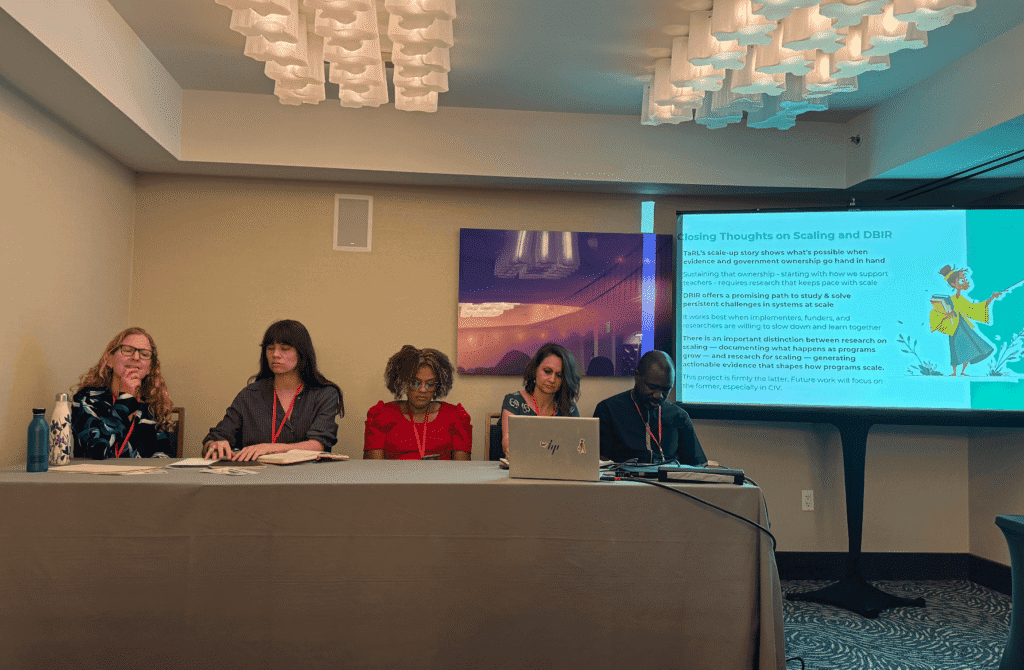
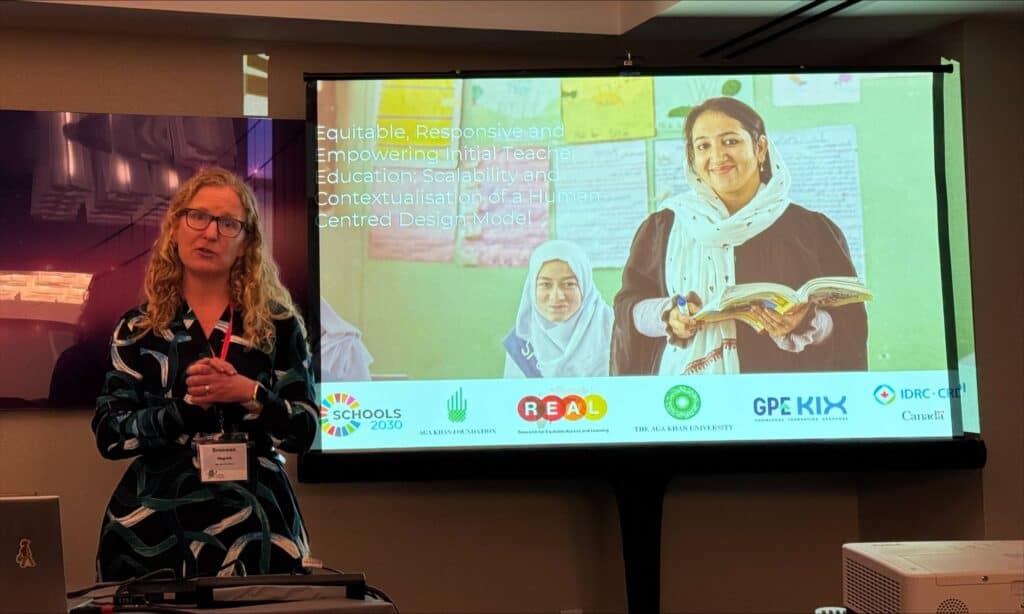
Bronwen Magrath’s panel made this case at the system level, drawing on our GPE-KIX funded project to embed and scale Schools2030’s Human-Centred Design (HCD) model inside Initial Teacher Education (ITE), with Thogoto Teachers College in Kenya as the anchor case. Her argument was that navigating an increasingly complex and unpredictable world requires teachers who are agentic, reflective professionals — and that this in turn requires a fundamental shift in teacher professional development, away from knowledge transmission and toward the deliberate cultivation of agency, starting at the very first step of the journey in ITE. What I found most useful was the three-level theory of change she walked us through. At the practice level, horizontal scaling — tutors, student teachers, and college leadership at Thogoto becoming co-researchers, working through iterative cycles of classroom observation, interviews, and reflection to identify which elements of the HCD model belong in their curriculum, pedagogy, and lesson planning. At the organisational level, embedding HCD into the modules, core courses, and practicum design of the institution, so reflexive professionalism is baked into policies and procedures rather than tacked on. And at the institutional level, working through national advisory groups to align Teacher Standards and ITE curriculum frameworks with these innovations. It’s a distinction that gives real shape to what we mean by “scaling” — a word that’s too often left vague — and grounds it in the relational work of stakeholder engagement and coalition-building that actually shifts practice.
Rayana’s second paper brought the same multi-level picture to life from the in-service side. Drawing on 2025 stakeholder consultations across Badakhshan, Bamyan, and Baghlan, she showed how the Three-Step Model is functioning as a “bottom-up ecosystem” in Afghanistan — HCD-trained teachers identifying learning gaps and co-designing innovations; School Management Committees, parents, and civil society partners taking ownership of the showcase and uptake; local education authorities, including the Teacher Professional Development Unit, engaging with the evidence and advocating for wider adoption. Twenty-two more schools have taken up Schools2030 approaches in the past year, which in that context says something about both demand and credibility. Her argument was a powerful version of a claim the wider network has been making: meaningful system-level change in fragile contexts can be seeded from below, through teacher-led innovation grounded in community partnerships and backed by evidence.
Another Schools2030 research partner, Nikhit D’Sa’s presentation took this into the leadership layer of the ecosystem. Drawing on the first national survey of primary school head teachers in Rwanda — a representative sample of 310 head teachers across all 30 districts, aligned to Rwanda’s 2020 National Professional Standards for Effective School Leadership — his research offered the first empirical snapshot of how the country’s leadership standards are being understood, practiced, and developed in the field. The preliminary findings show where head teachers’ self-reported skills align with national expectations and where gaps persist, and surface meaningful patterns across different school contexts. What made it relevant to Schools2030’s wider agenda was the framing: effective school leadership isn’t a parallel track to teacher agency and better instructional practice — it’s a precondition for them, and if national leadership standards are going to translate into classrooms, they need national-scale evidence of how they’re actually being put into practice.
The best assessment conversations at CIES were not about which tool is most rigorous — they were about which tool is most appropriate for the question, the people, and the context.
Across multiple sessions, the message was consistent: the presentations that moved me most were the ones where teachers presented alongside researchers as co-authors and co-investigators — not as subjects of study, but as partners in generating knowledge about their own practice.
What we’re taking back
These panels, taken together, paint a picture of a field more ready than it was even two years ago to take seriously the things Schools2030 has been building toward from the beginning.
The best assessment conversations at CIES were not about which tool is most rigorous — they were about which tool is most appropriate for the question, the people, and the context. That reframe matters. It shifts the field from defending instruments to justifying choices, and it makes space for the kind of participatory, teacher-led measurement work we’ve been investing in across all ten countries — and the BEQI Mombasa RCT is a powerful reminder that good measurement, when paired with light-touch feedback, can itself be a lever for teacher practice change.
Inclusion is becoming the theory of change, not an equity add-on. From the BEQI disability-inclusion pilot in Homa Bay and Mombasa to the MYRP’s approach to reaching girls and marginalised children in Afghanistan, the strongest work at CIES treated inclusion as the thing producing the outcomes — not the thing to be measured after the fact.
Teacher agency isn’t just a value statement — it’s an evidence base, and it scales when we build the ecosystem around it. Bronwen’s ITE work, the Schools2030 Afghanistan evidence, and Nikhit’s Rwanda head teacher study argue for an integrated, multi-level approach — from individual beliefs and classroom practice through school leadership and institutional culture to community partnerships and national policy. That’s the kind of resilient, agentic teaching profession a complex world demands, and it’s what our growing body of teacher-led research across the network is actively building toward.
These threads are feeding directly into our current teacher agency synthesis work across the Schools2030 network. In September this year, teacher agency and how it can be baked into the profession through professional development systems will be the topic of our penultimate Virtual Forum – watch this space!
Photo Credits: Top, Abbie Raikes, Gallery, Andrew Cunningham.