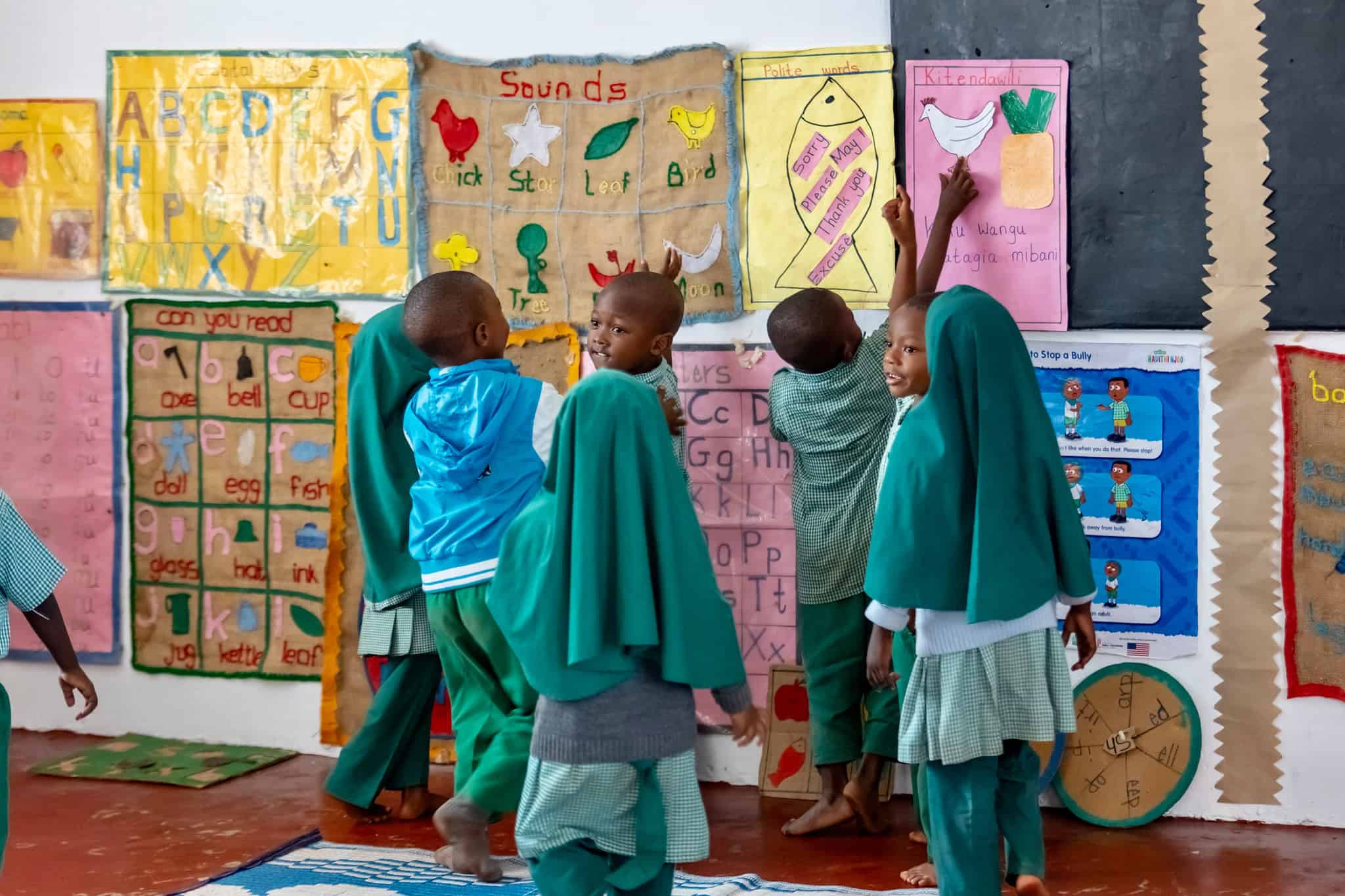
Walk into a preschool classroom in Afghanistan, Kenya, or Portugal and you will see very different things. But look past the language, the resources, and the room itself, and the questions that matter most are remarkably similar: is the teacher talking with children, or at them? Are children choosing, exploring, playing? Do they feel safe enough to try? The BEQI – the Brief Early Childhood Quality Inventory toolkit – is a measurement tool and integrated system for classroom environments, designed to answer exactly those questions, simply, reliably, and at scale, while translating data into timely, actionable feedback for teachers. We spoke to the team who lead this work – ECD Measure – about how it works, why simplicity is a design choice rather than a compromise, and what it really takes to turn classroom data into better teaching.
BEQI focuses on four domains: play-based learning, learning through conversations, strong relationships, and safe and stimulating environments. Why these four?
Each domain is grounded in strong global evidence about how young children learn. Within them, we focus on specific, evidence-based practices that are within teachers’ control and content-agnostic – things that can happen throughout the day, regardless of curriculum or resources. Play-based learning supports agency, problem-solving, and executive function. Learning through conversations builds language, cognition, and thinking. Strong relationships underpin everything – children engage when they feel safe and connected. And safe, stimulating environments ensure children have access to materials and conditions that enable exploration.
Crucially, every item was selected because there is clear evidence it supports children’s development, and because it is visible, actionable, and relevant across very different contexts. That combination is what makes these practices both measurable and meaningful for improving what happens in classrooms.
BEQI works both as an external observation tool and a teacher self-reflection tool. That must create some tension — what happens when what an observer sees doesn’t match how a teacher sees their own classroom?
We actually see this happen regularly, but we see that tension as productive rather than problematic. The observer and the teacher are capturing different, equally important realities. The self-assessment reflects what teachers believe they’re doing – their intentions, priorities, and understanding of their own practice. The observation captures what is visible in practice. Those aren’t always the same, and social desirability bias is real, especially when reflecting on practices we know are expected.
Rather than treating mismatches as a problem, we treat them as useful signals and a starting point for reflection. “Am I offering children choice as regularly as I thought? Are there moments where this is happening, but not as frequently or visibly as I assumed?” The goal is not to correct teachers, but to support more accurate self-awareness and more intentional practice. When both perspectives are used together, they create a much richer and more actionable picture of classroom quality.
Schools2030 works in some of the world’s most resource-constrained settings. What were your non-negotiables in keeping BEQI genuinely usable there? How does the tool account for teachers’ realities?
Our team designed BEQI based on extensive experience using much more complex classroom observation tools. We saw that many existing tools are complex, expensive, and research-oriented, and that the results often aren’t accessible or usable for teachers. In our work around the world, we consistently heard that feedback from classroom observations, if provided at all, is often delayed, deficit-focused, and not clearly linked to how teachers can actually improve.
So we asked: what would it take to measure quality feasibly at scale and genuinely support teachers? That led to a few non-negotiables: practices had to be clear, observable, mostly binary (yes or no) and within the teacher’s control. Training had to be achievable in around eight hours, with reliably high pass rates. No prior early childhood expertise should be required to use the tool. And a 90-minute observation window makes it viable even in large systems.
Most importantly, through the BEQI system, teachers receive their results immediately, not weeks later, directly to their phones via SMS or WhatsApp, in their own language. That last piece matters enormously. It shifts feedback from something evaluative and abstract into something teachers can actually use, in real time, in their own classrooms.
Consistency in core practices enables cross-country learning. Flexibility in alignment ensures local relevance.
You use a straightforward yes/no scoring approach. What are the trade-offs of keeping the tool that simple?
Simplicity is a deliberate choice, and it does come with trade-offs. What we gain is usability at scale, faster training, clear and actionable results, and a much higher likelihood that the data is actually used. What we give up is some nuance and granularity, and a degree of sensitivity to very subtle differences in quality.
But based on feedback from users around the world, a slightly less granular tool that focuses on concrete, visible teacher practices turns out to be more valuable for behaviour change than a richer tool that goes unused. Usability isn’t a compromise – it is the point.
Preschool education looks very different in Afghanistan than it does in Portugal or Kenya. How do you keep BEQI locally meaningful without losing the ability to learn anything across countries?
This is a core design tension, and one we address very intentionally. We keep the core domains and evidence-based practices consistent across countries, while building in flexibility through a structured alignment and adaptation process. In each country, we work with local teams to align BEQI items directly to national early childhood standards. On average, around 76% of BEQI items directly align with national standards across countries. Where there are gaps, country teams can adapt or add items – some have added indicators on mother-tongue instruction or specific infrastructure requirements, for example.
At the same time, BEQI focuses on process quality – what teachers and children are actually doing – which national standards sometimes under-define. In that way, the tool can also help operationalise policy, acting as a bridge between what countries say they value and what is actually happening in classrooms. Consistency in core practices enables cross-country learning. Flexibility in alignment ensures local relevance. Both matter.
What’s the thing you most want people to understand about BEQI that often gets missed?
That measurement alone doesn’t improve quality. What matters is what happens after the measurement.
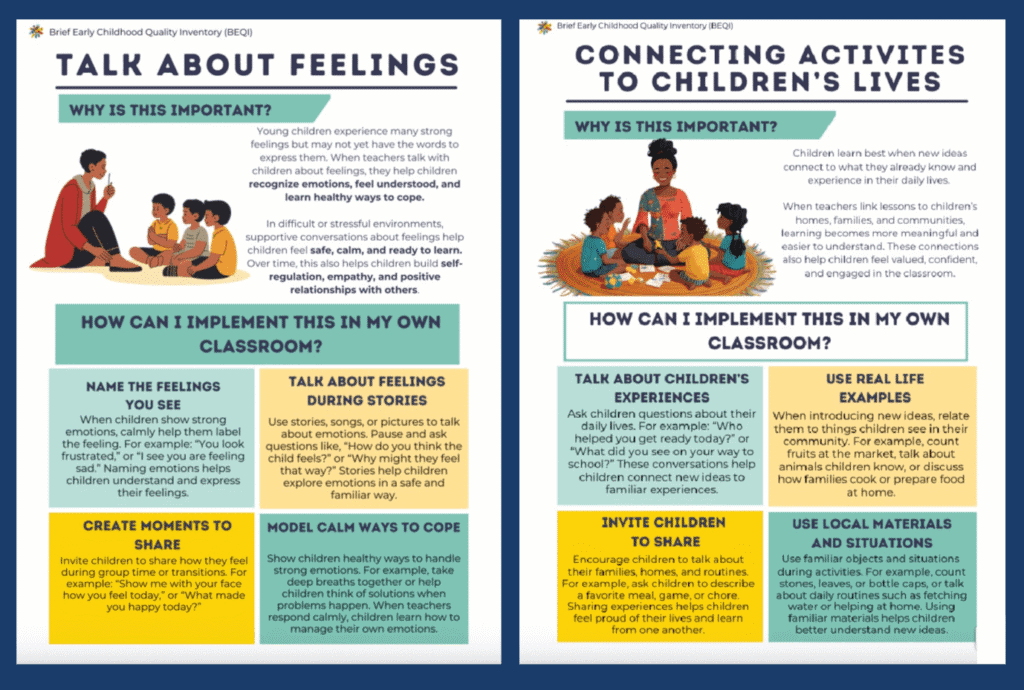
The system around BEQI is just as important as the tool itself. After each observation, teachers receive immediate, individualised, strengths-based feedback directly to their phones, in their own language, highlighting what they are already doing well and identifying a small number of specific, observable practices to focus on next, framed as “areas for goalsetting”. In many contexts, this is the first time teachers have ever received timely, actionable feedback tied to their own classroom practice.
This approach has been shaped in close partnership with Schools2030 country teams, national coordinators, and teachers themselves, who have been instrumental in testing and refining the system. We think about BEQI not just as a measurement tool, but as part of a broader system for continuous improvement – one where data drives reflection, reflection drives better practice, and teachers are at the centre as active users of their own data, not passive subjects of someone else’s report.
Explore the BEQI Tools in more detail and join us on 7 May to hear from teachers on the front lines of this work