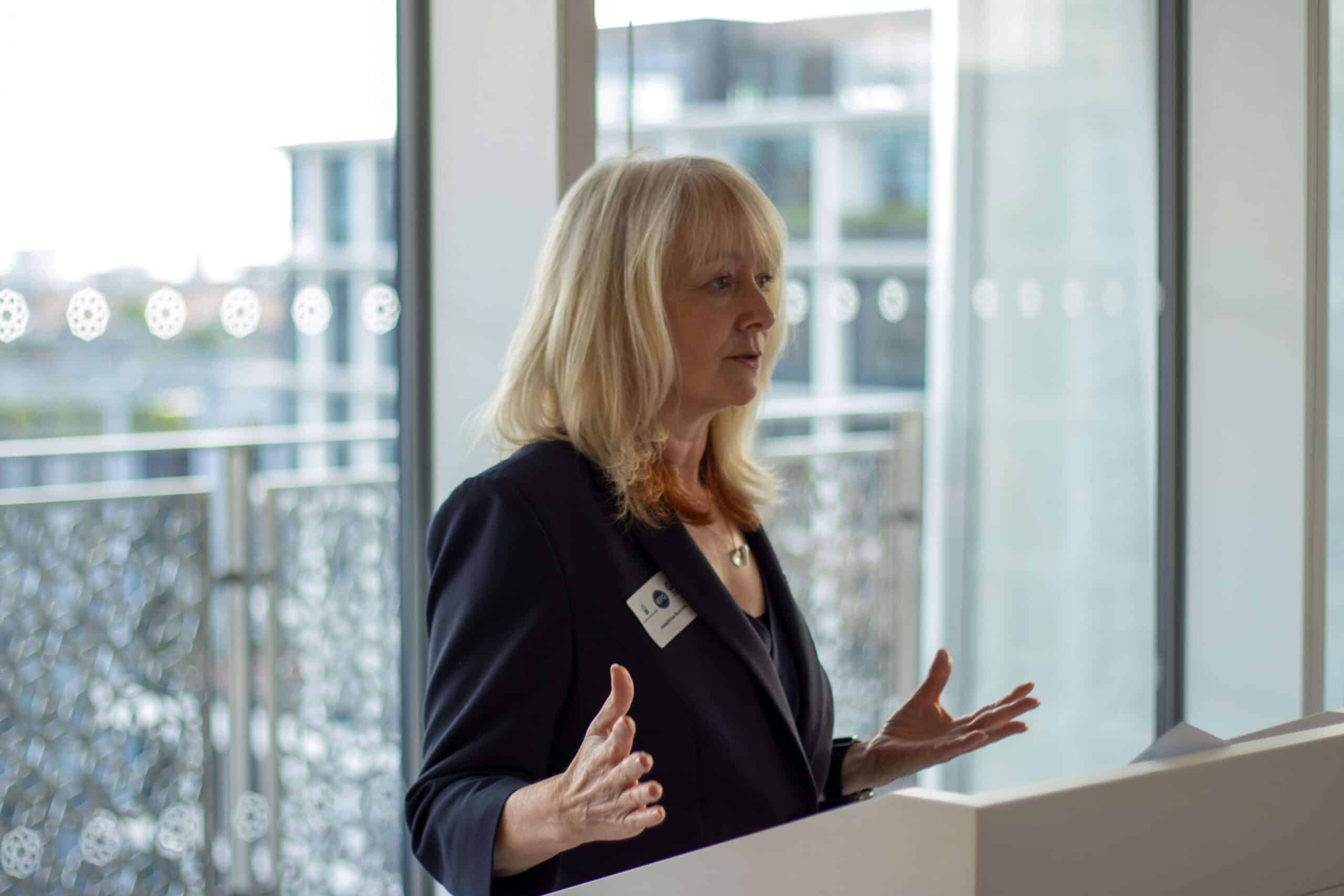
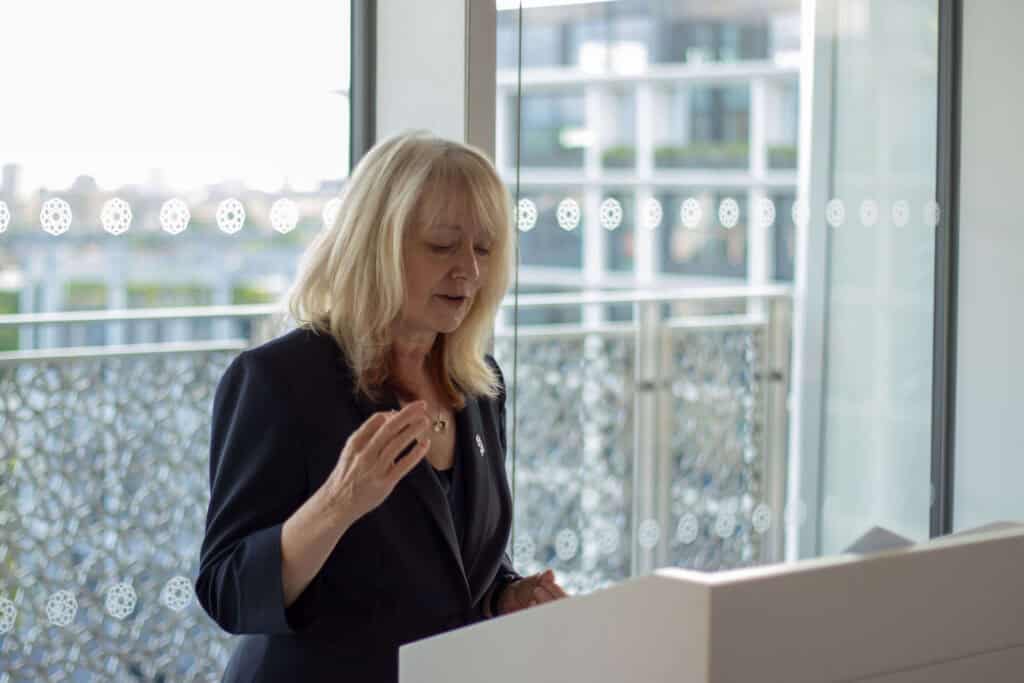
Jo Bourne is Chief Technical Officer of the Global Partnership for Education (GPE), the largest global fund dedicated to transforming education in lower-income countries. Last month, she spoke at Part 2 of the Schools2030 Virtual Forum series, which focused on leveraging evidence in and for classrooms. Her timely intervention comes after the publication late last year of the GPE’s 2030 results framework (see annex 1), placing learning outcomes and teachers at the centre of how delivering impact at scale. The session brought together a rich chorus of voices – teachers, practitioners, academics– all converging on a single, urgent message: assessments must be co-created with teachers, and the evidence they generate must reach those teachers in real time, so they can act on it.
We sat down with Jo the morning after the Catalytic Philanthropy 10×10 Dinner in London, co-hosted by GPE, AKF and the International Education Funders Group (IEFG). This dinner is part of a series of similar convenings happening across the world, which bring together a range of education leaders and philanthropic donors as part of GPE’s “Multiply Possibility” Campaign, co-hosted by the Prime Minister of Italy, Giorgia Meloni, and the President of Nigeria, Bola Ahmed Tinubu. At the dinner, Jo spoke alongside the Minister of State for Education of Rwanda about the future of education financing – and GPE’s campaign objective to raise 5 billion USD, and unlock an additional 10 billion USD, to support 748 million learners across 96 countries to deliver on the promise of equitable, quality learning for all.
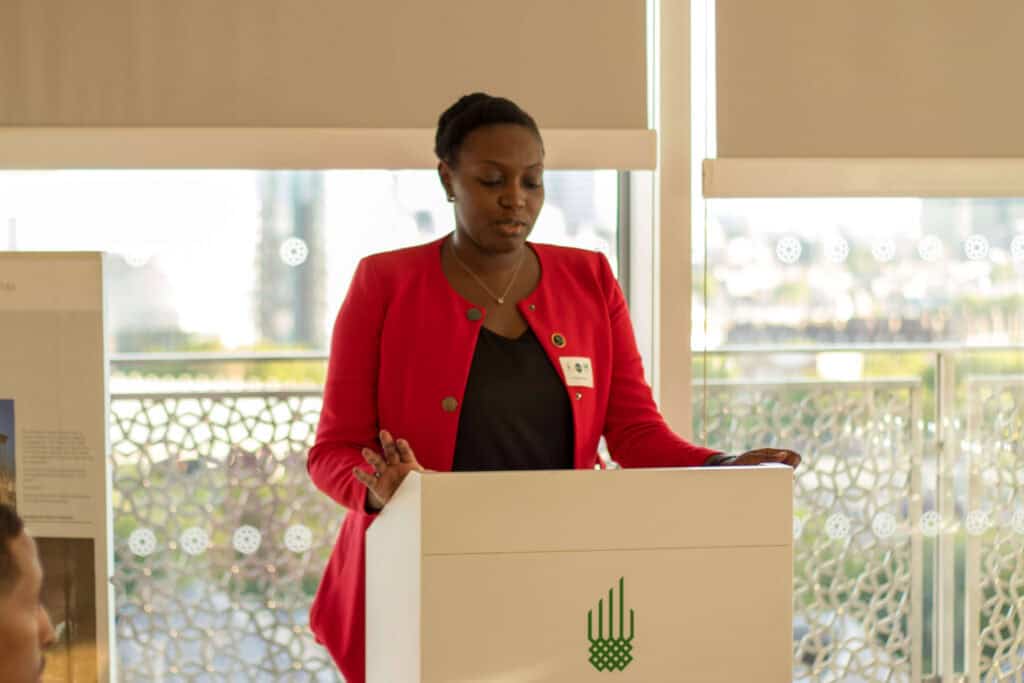
Hon. Claudette Irere, Minister of State for Education of Rwanda
But what does this look like in practice? What does GPE’s new results framework mean for students, teachers and funders? And how do we keep teachers at the centre when the scale of delivery is so vast? Given this shared priority for Schools2030’s catalyst year, we spoke to Jo about GPE 2030’s results framework, the central role of teachers and education communities as agents of change, and why now is not the time for the international community to step back from its commitment to quality education for all.
You spoke last month at the Schools2030 virtual forum and mentioned that you were a teacher. Could you tell us a little more about your background, first as a teacher, and then your journey to where you are now? How has that informed the work you do with GPE?
It’s a really big question, because my passion for education also comes from a passion for social justice, something I picked up quite early in the UK system. I failed an exam that would have determined whether I went to a secondary modern or a grammar school. I ended up at the grammar school despite failing, but that sense of being streamed one way or another at the age of 11 or 12 didn’t seem right. Being told you’re not good enough for something because of the way you learn, I think that was at the heart of it. That sense of some children being pushed in one direction and denied opportunities compared to others was really the social justice piece.
So I went into teaching. I also had people in my life who were teachers and whom I was inspired by, and that always makes a difference. What I found as a teacher, both in the UK and overseas, is that you have to innovate in the classroom. You’re constantly working with children to solve problems. You have content and curriculum, but your job is to facilitate it. You have to be an actor, a facilitator, and a collaborator. And it wasn’t just about being in the classroom with a group of children; it was about what that meant on a global scale too. I worked overseas as a volunteer teacher, and it all came together from there.
GPE has just launched a new results framework spanning 96 countries and territories. What’s been the impetus behind this, and why is the timing so critical?
There are so many answers to this. First, anyone investing in education, and the majority investor is governments themselves, wants results. And those results are learning results, across a whole breadth of areas: foundational learning, including social and emotional learning, and much more besides. There’s also a broader conversation happening about the relevance of education for a very fast-changing world.
There are plenty of positive examples of how to measure different results. What is lacking is a way to do that at a large aggregate level for a fund like GPE, one that reflects both our effect as a partnership and our effect as a funder, working through many different partners. Getting aggregate results across all of those without setting things up properly from the start is an enormous challenge. That’s one of the real game-changers in how we’re working. It sounds modest, but it’s actually quite significant: we are setting a bar that hasn’t been set before. We’re being flexible about it, because our whole approach is about meeting countries where they are. We’re not prescribing exactly what must be measured and how, but we are saying that our investment has to count for something.
Of course there’s plenty of good innovation out there in the measurement space, a lot of it quite small-scale. Many of the organisations we speak to ask: “Why can’t you do this? We can do it.” And the answer is: we have to do it across 96 countries, with more than 30 grant agents, and we’re more than just our funding. We work with governments to strengthen their systems so they can do it themselves. That’s the most important part. Helping our partners understand the magnitude of the challenge and having their support to take first steps even if they’re not perfect, has been really important. We need to be on that journey together.
Indicator H4 is a new addition to the GPE2030 Strategy, putting learning outcomes at the centre for the first time. What does this look like in practice?
On one hand, we talk about measurement for learning rather than measurement of learning, meaning that the evidence needs to be in the hands of teachers so they can act on it. That’s not quite the same as measuring learning at the system level, where the question is: given this investment, is the system producing what we want from it?
I’m comfortable with both, because you need both. If we’re going to keep financing flowing for education, ministers of education need to be able to speak to ministers of finance, and those conversations involve hard results. I sometimes think there’s a false dichotomy: measuring something at an aggregate scale because it’s technically easier isn’t the same as saying that’s all we value. The real challenge for educators is getting assessment information into the hands of people who can act on it and linking those two things.
What we see from systems research is that when there’s strong political leadership focused on a specific goal, say foundational learning, and the whole system is aligned behind it, things start to happen. You see this in the municipality of Sobral in Brazil, for example. When everyone is pulling in the same direction, involving stakeholders in the system, from politicians to parents, it is possible to achieve and sustain results. So yes, we should be measuring foundational learning in a way that genuinely supports the system, but we should not stop there. Measuring broader developmental outcomes, particularly in the early years, is not impossible. We have examples of where that’s been done well. We need to keep generating that data and, crucially, making sure it flows downwards to teachers, not just upwards.
Getting aggregate results across all [our many partnerships] without setting things up properly from the start is an enormous challenge. That’s one of the real game-changers in how we’re working.
GPE works through governments, grant agents, and implementing partners. How does that partnership approach make measuring holistic outcomes possible at scale?
It’s not going to happen overnight. Because we largely work through governments, we need to listen to governments , and they’re at very different stages in their approaches to assessment. Some are actively experimenting with new ways of measuring at national scale. Some are interested in pilots happening in their country but aren’t sure how to take them to scale. And some are struggling to even get started on measuring the things we know matter.
A lot of how we work is about asking governments: what’s your pathway, and how do we as partners help you along it? We have to be humble in that space. I don’t see GPE’s job as going out and telling everyone what to do. Through our grants, by signalling that we value learning outcomes in any domain, including holistic ones, we’re opening doors for more innovation where things are actually working. But it’s not going to be quick. It couldn’t possibly be, for something this complex across 96 counties and territories.
Teacher professional development outcomes sit alongside learning outcomes as a headline indicator. What does that signal about how GPE sees the role of teachers, not just as delivery mechanisms, but as active agents of change?
If you look at our overall theory of change, it comes down to this: if a government has a prioritised reform, one that genuinely attends to inclusion, gender equality, and the specific challenges in their context, and if we can align financing and partnerships behind that reform, we also need to align stakeholders. When we were discussing this with the GPE Board’s Performance, Impact and Learning Committee, one of our partner governments made the point that this is fundamentally about core system stakeholders, not just aligning external financing, but engaging the people who are part of the education ecosystem at a much deeper level.
When you start thinking about core system stakeholders, you can’t leave out teachers, teachers’ organisations, parents, communities, or district-level actors. What we see in countries that are making progress is that they are very intentionally engaging their own citizens in conversations about what needs to happen, listening, bringing people along. That’s not easy. And of course, teachers have expertise to bring to the table, along with real challenges that might prevent them from doing their jobs better: distances to school, housing, gender dynamics within the profession. A lot of what we try to do at the country level is make sure those voices are heard and that government leadership is genuinely engaging its own stakeholders.
Indicator H5 is about teacher training, which is an output rather than an outcome. We’d all love to be able to say that teacher training translates directly into effective classroom behaviours. There are good observational tools out there, and many of our grant agents are using tools like Teach, but taking that up to a meaningful level of aggregation across countries or portfolios isn’t happening systematically yet. And that’s not something GPE can tackle alone. It’s going to require the kind of concerted effort we’ve seen with learning outcomes data, working through organisations like the UNESCO Institute for Statistics to establish shared criteria and standards. It’s technically very complex.
The evidence on what works is increasingly strong: mentorship, coaching, teacher self-reflection, even some ownership of action research, being innovators in their own classrooms. All of those things work. Getting an entire system to do that at scale requires government leadership, local innovation, and a whole range of other things. That’s where partnership comes in: connecting good practices and supporting countries on the journey they’ve set for themselves. Because at the end of the day, when it comes to teacher training, the majority funder is the national government.
What role do private foundations play in driving this agenda? Why does the 10×10 dinner series, co-hosted by AKF and the International Education Funders Group, matter as a mechanism for keeping learning outcomes and teachers at the centre of conversation?
Governments have non-negotiable commitments to finance, and they do so as best they can. But additional financing, to put evidence into practice, is still needed. At last night’s 10×10 dinner what we heard clearly was: work with us more intentionally. It’s not about crowding out innovation or bringing it under control; it’s about being more thoughtful and coordinated. The days of one literacy project over here, one numeracy project over there, a digital skills project somewhere else, all calling the same teachers in for training at the same time, those days need to end. There needs to be more intentionality around that, without stifling the innovation that is genuinely needed. That means working more closely behind government leadership, co-creating with government so there’s no duplication, and being willing to adjust models to fit both the context and what else is happening within it.
One of the big messages from that dinner was that GPE isn’t about overriding philanthropic innovation. It’s about encouraging more thoughtful collaboration behind government to multiply impact, not just multiply financing, but multiply effort and multiply outcomes.
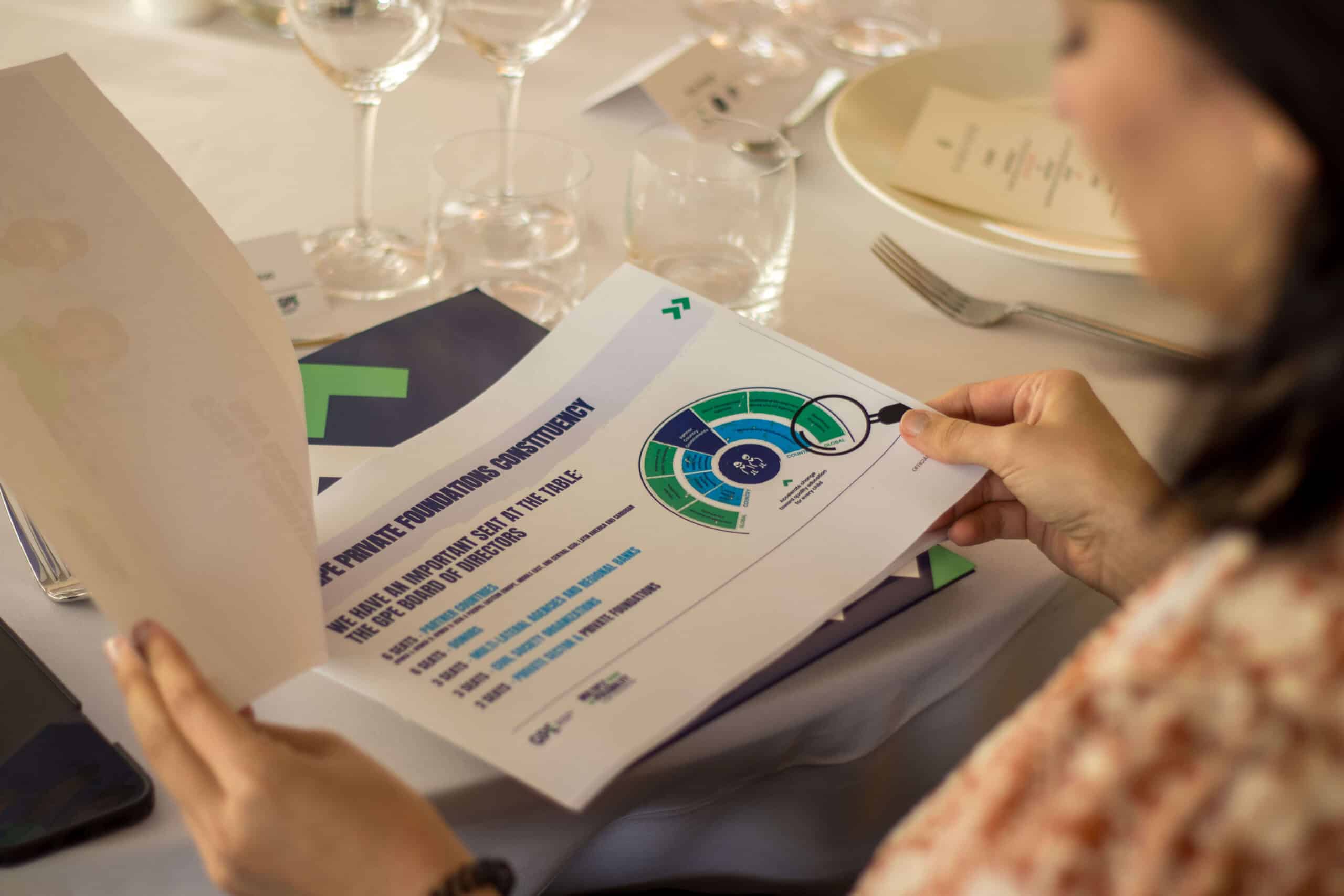
GPE’s replenishment event is happening alongside UNGA this year. What is your overarching message to participants about why measuring learning outcomes and teacher professional development are so central to the future of education, and why it matters that we pull our impact together in this way?
Taking these steps towards a more systematic way of measuring learning outcomes at the system and grant level is critical for the survival of a global fund in education, and frankly for ministers and domestic financing too. But that message won’t resonate with everyone.
In this very difficult environment for financing, both domestic and international, there are other messages that matter. One is about education as an investment in future stability and prosperity: what happens if we don’t keep education going in these places? That resonates in many contexts. Another is that we are no longer about filling gaps with short-term projects. Last night the Minister of State for Education for Rwanda made this same point: NGOs too often come in, do something good, then leave, and governments are left to pick up the pieces without the discretionary financing to do so. I’ve been in this job long enough to have seen that first hand. So, working with countries to think systematically about long-term, sustainable financing for education is a message that resonates too.
And the focus on results resonates very strongly with our ministers. That is what they want: the evidence, the innovation, people pulling together to help them get results. In terms of keeping education on the political agenda, there have been some great articles even in the last couple of days here about other governments stepping up. We cannot let this go backwards, because we will regret it if we do.
We learned from Covid. The minute education was suddenly denied, for all the reasons it was, everybody panicked about the impact it would have. And we are still living with those impacts, including here in the UK. So ,take that and scale it up. Think about what the post-2030 sustainable development goals will look like. Virtually every single thing we want, economic growth, peace, equality, health, has education as a fundamental component. Education will continue to change, and that’s exciting, but it still needs financing from multiple sources and the innovation to put that change into effect. Now is not the time to scale back.
Thank you so much, Jo.
Closing Reflection – A Catalyst for Change
As Schools2030 marks its catalyst year – five years of building evidence from classrooms outward, placing teachers at the heart of system change – Jo’s words carry particular resonance. The results Schools2030 has helped generate, through teacher-led innovation, holistic assessment, and schools-to-systems thinking, are precisely the kind of evidence the GPE 2030 strategy calls for: grounded in practice, co-created with educators, and designed to flow back to the people who can act on it. As GPE enters its next strategic phase with learning outcomes and teacher professional development as headline indicators, Schools2030 offers a ready body of evidence and a set of proven approaches to help shape what comes next. The catalyst year is not a conclusion: it is a contribution to the longer arc of change that Jo describes: intentional, system-wide, and built on the belief that teachers are not just recipients of reform, but its authors.
Watch Jo Bourne’s contribution to the second part of the Schools2030 Virtual Forum series